Friday, November 17, 2006

Toads

Things have been moving up a gear for “Deliver Me” – we’ve been crewing up, finding locations, I’ve started shot-listing, storyboarding and shot designing and we’ve got a casting director on board. I’ve written before about how I find casting quite weird – so it’s good to be working with someone who can feed into the process and provoke me to think about different options.

Script-wise, I think we’re there – as far as having a shooting script goes. We had another meeting with Paul Welsh the other day which was entertaining and confusing simultaneously (confutainment? ). Honestly, there was a 15 minute period where he was trying to explain to me where he thought the script could go - he seems keen on me rewriting up until we shoot –(which kind of happens any way as a byproduct of casting, story boarding, finding locations and rehearsing) - and I still have no idea what he was suggesting.

Maybe it’s me – maybe I lack some specialist auteur apparatus that allows me to interpret mime - “at the moment the script seems to be doing this” – a hand heading diagonally down – “and then does this” – the hand heads up, like a big tick. Certainly, there seemed to be an implication that I maybe wasn’t pushing story as far as it could go – “how much further can you do? How much further do you want to go?”. It might be me being paranoid, but I do get the feeling that I’m not being “real” enough – that because I essentially think the film as a genre piece that it’s going to be hokey and idea-driven rather than “true”.

This a similar point of view to one expressed by Lenny Crooks, the new head of the Film Council’s New Cinema Fund who did a meet and greet in Nottingham a couple of weeks ago. He began his introduction about the kind of films he wants to fund with the words “I’m interested in truth, I’m not interested in genre.” “Red Road” (interestingly marketed as ‘a thriller’), “London to Brighton” and “This is England”, were all films he cited, which sounded like – at least for the New Cinema Fund – “truth” equates with a certain kind of dirty realist drama. Horror would only be acceptable if it was in a David Lynch/David Cronenberg arthouse vein - and even then, I very much doubt they would fund another “Shivers” or “Eraserhead”.

The meeting just made me think, “well, this isn’t for me then”. Which is fine – at least I know. But it’s weird to think that whole genres of filmmaking can be discarded for being more “untrue” than others. To me something like Andrea Arnold’s Oscar/Bafta winning "Wasp" is more unreal than “Suspiria”, precisely because it presents itself as being “reality” rather than an entirely fictional construct. At least “Suspiria” acknowledges that it’s a story. Which maybe makes it more honest.

The American poet Marianne Moore once had a great phrase about poetry being “real toads in imaginary gardens”. And surely that’s all that counts – regardless of the setting, you can create a truth for your characters. Is not as though the minute you start writing horror films you have some kind of creative lobotomy – although the amount of people who ask me “why do you like horror, is it because of all the guts? “ or similar suggests that there is a very pejorative view of horror fans and makers – in fact, I think it’s the opposite – it frees you up to think in new ways. Obviously there are bad and cheap and shallow horror films, but there are also a bad and cheap and shallow realist dramas. Realism doesn’t equal truth – is just another kind of fakery.

Tuesday, November 07, 2006

287 Days Later

Astonishingly, after nearly 10 months (287 days to be precise...) we've been sent a draft contract for the DVShortsPlus scheme. Leaving aside the slight anomaly of this contract only being drawn up now - ONE YEAR after the scheme was first announced and FIVE WEEKS before we start shooting - this means that, potentially, if we're lucky, some time in the next few weeks, we might actually be allowed some access to some money, which will be One Hell Of A Good Thing, because it's very hard to make a funded film without any funding.

It also means that, for the first time, we get to see what we have to provide in order to get some money, what the deliverables are and how the recoupment percentages stand (recoupment, hah!). Although there's still no word as to whether the UKFCers have approved the script, so maybe I'd better hold my tongue...

Monday, November 06, 2006

Mushing Together Sex and Horror


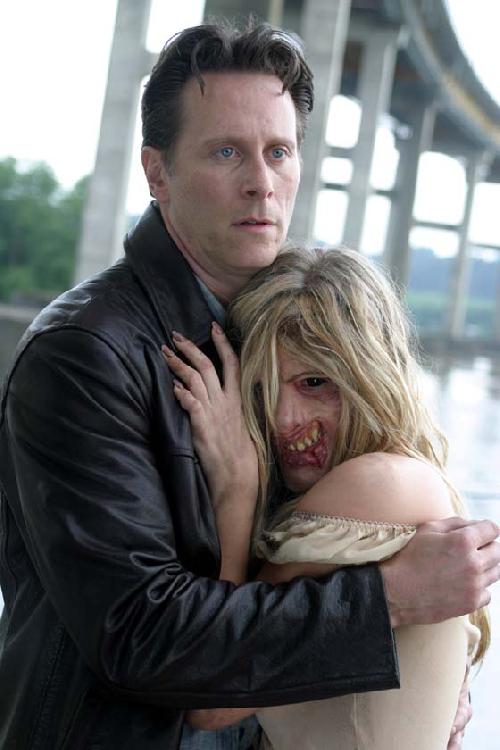
A few days ago - after much prompting from Cooke - I finally got around to watching Dario Argento’s episode of the Masters of Horror TV series – “Jenifer”.

I’ve been a big fan of Argento’s for about five years, ever since I saw “Deep Red” and even though recent films like “Sleepless” and “The Card Player” are way off his absolute best, there’s always something in his films that’s memorable and provocative. With “Jenifer” he has a lot of fun referencing Beauty and the Beast (the fairy tale rather than the Disney singing telephone film (or even the Eighties big hair fantasy drama ) ) and Frankenstein while at the same time exercising his own preoccupation with duality and the meshing (or mushing ) together of horror and desire.

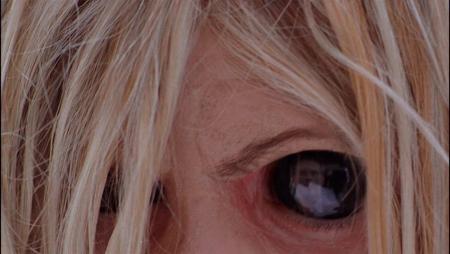
Based on an old “Creepy” comics story, “Jenifer” is about a cop who saves the life of a young woman, about to be murdered by a formerly well-respected man now reduced to vagrancy. The young woman – clad only in a flimsy flighty summer dress – has a great body but a hideously-disfigured face. Unable to speak, she instead makes half-animal, half-childlike noises – whining, crying, growling, sometimes almost purring.


The cop, on finding out that she has nowhere else to go, decides to take her home and put her up at his house for the night. However, in a shining example of HusbandDickery, he doesn’t bother to wake his wife and tell her that he has given couchspace to a hideously-deformed, but scantily-clad woman-child – (and this the day after he’s tried to force his wife into rough anal sex while remembering his first glimpse of Jenifer – bound and bent over an old oildrum, a machete raised above her head ) – so that when the girl appears in their bedroom the next morning she scares the life out of both his wife and his teenage son – who recovers his wits quickly enough to note “hot body!”.

When his wife insists on getting rid of Jenifer, the cop drives her out to the wilderness (like he’s getting rid of a stray dog ) but can’t seem to let her go. Jenifer – obviously fixated on the cop – starts nuzzling up to him in the car and before long they’re fucking on the front seat – roughly, animalistically. It’s all wrong – not because she’s deformed, but because she seems so childlike – and like an animal at the same time – she’s sexually aggressive, but like a dog in heat.

The cop (continuing the HusbandDickery ) brings Jennifer back (‘hey, she can’t speak, how’s she gonna tell anyone…’) and while he and his wife argue, Jenifer runs upstairs to the bathroom – from where some strange sounds soon start to emanate. They rush upstairs and find Jenifer crouched over the eviscerated body of their cat, filling her mouth with its guts.


This, unsurprisingly, is the last straw for his wife, who leaves, taking the son with her. The cop, momentarily wondering what he has got himself into, soon has his mind taken off this by having some more rampant sex with Jenifer.

You can kind of see where this is heading, and it doesn’t surprise you when we find a replay of the opening scene at the end, but the tone of the film – with its deep black humour and strange, dreamlike feel - the cop seems intoxicated long before he starts on the brown paper bag – really reminded me of Argento’s section of ‘Two Evil Eyes’, ‘The Black Cat’, which is another tight little piece (again an adaptation.)

Of course, lots of Jenifer is quite hokey - and in this it maybe shows its comic book roots – there’s a freak show in town, for example (do they still have freak shows? ) and the cop ends up getting a job as a handyman in a local store (which is a job a hobo in the 30s might get ) - but then Argento’s never exactly been one for a gritty realism – and the story (rather than the plot ) is what he’s interested in.

The film is tightly shot, with some great makeup effects, and it never drags. Some people have complained it’s not scary, but then I never think horror films have to be – they can be, but a lot of horror films I see work because they’re horrifying rather than scary. And Jenifer is horrible because of what is says about male desire and the link between sex and horror – and because it doesn’t explain everything away.

Apparently, there were couple of deleted scenes (which caused John Landis to freak out) which show how far Argento’s prepared to go with his imagery and I think it’s a shame they weren’t included – not out of a gratuitous gore-thirst, but because I think they would have really pushed home the monstrous sexual element of the story.

Good to see that he can still push the boundaries in an interesting way. Now bring on the new Three Mothers film...